2 min read

Making the most of duct space: Challenges and opportunities

Making the most of duct space: Challenges and opportunities

When people talk about fiber networks, the spotlight usually goes to the cable itself. But ducts, the conduit that carries it all, may be the most undervalued asset in the ground. Managed well, they can speed up deployments, extend the life of infrastructure, and even open up new revenue streams through leasing. Managed poorly, they become a bottleneck that slows projects and inflates costs.


Why do ducts matter?

Ducts are more than protective tubes. They make it possible to add capacity without tearing up streets every time new fiber is needed. Inner ducts take that flexibility further by dividing a larger conduit into smaller paths, allowing multiple cables or even multiple tenants to safely share the same space. That design is what gives duct networks long-term value. When tracked accurately, ducts let providers:

  • Add fiber faster by using existing paths
  • Protect investments by reducing construction risk
  • Generate new revenue by leasing unused space


What makes duct space so complicated?

Even with GIS in place, duct records aren’t always telling the full story. Many systems focus on fiber while duct data remains incomplete, generalized, or siloed. That gap makes it hard to answer simple questions:

  • Do we actually have space to pull more cable?
  • Which paths are already leased, and to whom?
  • How close are we to capacity in this corridor?

Without clear answers, teams risk overbuilding, missing leasing opportunities, or running into construction surprises that drive up costs.


Where are the biggest opportunities?

The upside is significant. With accurate duct-level information, providers can:

  • Maximize utilization by pulling fiber through existing ducts instead of digging new ones
  • Create new revenue streams by leasing spare space with confidence
  • Plan smarter expansions by knowing exactly where capacity lives
  • Reduce risk by avoiding unnecessary construction in congested areas

Industry research backs this up: providers that focus on reusing infrastructure and simplifying build processes consistently see faster deployments and lower costs.2


How do you move from visibility to action?

Most operators already use GIS to track their networks, but not every system brings duct and fiber together in a way that supports planning, leasing, and construction all under one roof. That is where specialized modeling tools change the game, turning duct data from a static record into something teams can act on.

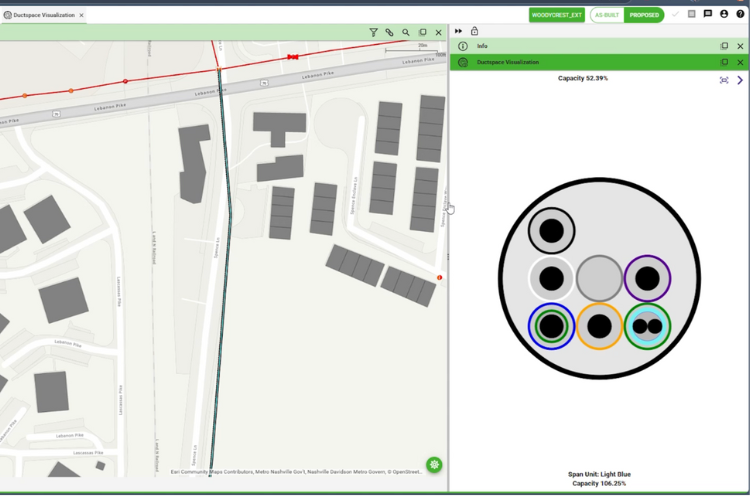
We recently explored this in a webinar, where our team showed how duct space visualization in 3-GIS | Web helps organizations see availability down to the inner duct, check fill ratios, and share clear visuals with planners, contractors, and lessees alike.

That kind of clarity makes ducts more than infrastructure. They become a live resource for growth.

If you cannot see what is available, you are missing chances to cut costs, accelerate builds, and even generate new revenue. The providers that treat duct space as a core asset, not an afterthought, are the ones setting themselves up for smarter, more sustainable growth.


See how duct space visualization works in practice and what it can mean for your network. Access the on-demand session, Stop wasting duct space: Turning buried assets into build-ready pathshere.


Citations

1 123NET, “Fiber Optic Cable Duct: The Backbone,” February 1, 2024
https://www.123.net/blog/fiber-optic-cable-duct-the-backbone/

2 McKinsey & Company, “The keys to deploying fiber networks faster and cheaper,” 2023
https://www.mckinsey.com/industries/technology-media-and-telecommunications/our-insights/the-keys-to-deploying-fiber-networks-faster-and-cheaper

Management solutions for the life-of-the-network

Management solutions for the life-of-the-network

The network is a multi-generational endeavor. It is ever changing from copper and coax to fiber and wireless. From planning and designing routes and...

Read More
Rural vs urban fiber network planning: The challenges and opportunities

Rural vs urban fiber network planning: The challenges and opportunities

The approach to planning and deploying fiber networks can vary dramatically between rural and urban environments. While modern fiber design software...

Read More
Beyond the build: Why operational truth matters more than ever

Beyond the build: Why operational truth matters more than ever

At some point in almost every transformation conversation, someone will say, “We just need a digital twin”. It sounds like the right answer. It...

Read More